In July of 1970, on our annual summer trip to Nova Scotia, I was nine years old, standing at the edge of a road near Musquodoboit Harbour in front of a rocky coastline, about to take a picture.
My father stopped me. He walked me under the bough of a nearby evergreen and positioned me so that just a few branch tips and pine needles hung into the top of the frame.
Foreground, he said. You need some foreground. Background and middleground aren't enough. The eye needs something to enter through, a visual on-ramp into the image.
The camera was a Polaroid, a Christmas gift he'd given me specifically to help me learn. In those days a Polaroid was the only way to get near-instant feedback on photographic technique. Every summer for seven years my father and I drove up for two weeks. He would bring his twin-lens medium format Rolleiflex and photograph the fishing communities and their colorful characters (and me, posing for him) while teaching me the fundamentals of photographic composition.
That morning on that road is my earliest memory of making an intentional decision about how to compose a photograph.
I've used that lesson ever since. Underwater, I think deliberately about how to use coral formations, wrecks, or sharks to be most pleasing to the eye, and how to use depth to create maximum drama. In the studio too, how to use both the subject and space to deliberately lead the viewer's eye through an image, and how to use light to tell the viewer where to linger.
So that's where my photographic journey consciously started. My family's photographic journey, though, started two generations earlier, on a flight over the English Channel on June 6, 1944. D-Day.
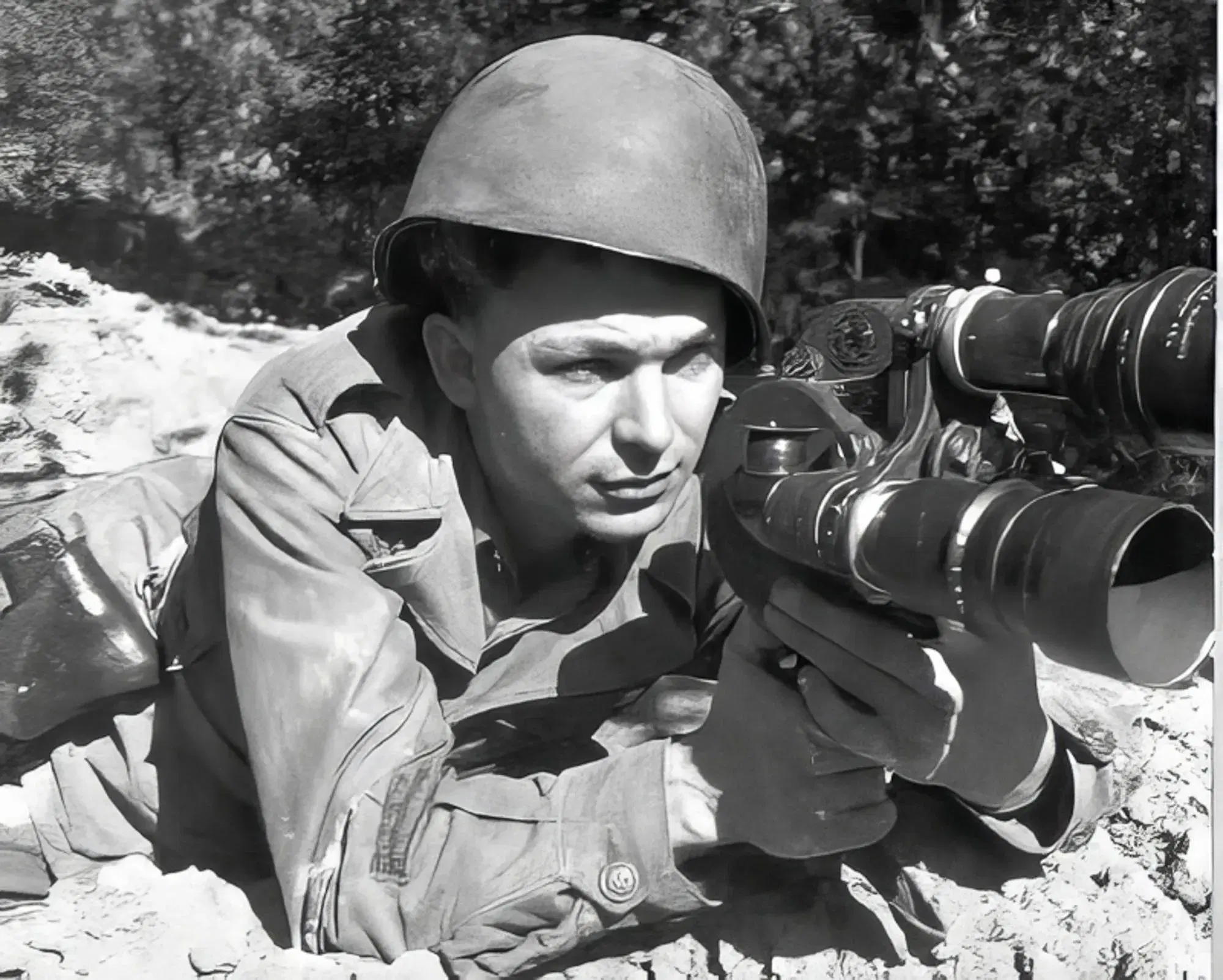
Three Generations Behind the Lens
What a combat photographer, a Polaroid camera, and a pine bough on a Nova Scotia road taught me about visualizing an image.
My grandfather Jim Bates parachuted into Normandy on D-Day in the second plane over the drop zone, because the generals wanted the photographers on the ground first, before the chaos started. He landed in a canal and went in over his head, weighed down not just by his battle gear but by an additional fifty pounds of photographic equipment he'd carried onto the front lines. He nearly drowned, fighting his risers underwater in the dark until a breeze caught his chute and pulled him to the bank. His camera equipment was flooded and useless. For the first two days of the Allied invasion of Europe, the 82nd Airborne's combat photographer was just another soldier in a field, wondering where everyone else had gone.
That's how he described it. In a 1994 documentary produced by the Pikes Peak Library District, and later in this Battle Guide documentary on the Cologne tank duel, Jim Bates (then 76 years old, still climbing Pikes Peak every New Year's Eve as the AdAmAn Club's official photographer) described D-Day morning with the dry humor of a man who had made peace with the distance between what he planned and what actually happened.
He was born in Boulder, Colorado in 1916. By the time he graduated high school in Colorado Springs he was already working at the Alexander Film Company, the largest producer of theatrical advertising films in the world at its peak, serving clients like General Motors, Ford, and Philco, producing upward of 3,000 films a year from a lot with 32 full-size motion picture sets. He worked there for seven years before the Army came calling. The reason was simple: they needed someone who already knew how to tell a story with a camera. He was twenty-six years old.
After D-Day he worked across the European Theater on General Eisenhower's newsreel team, with credentials that gave him authority to attach to any division at the front. He photographed FDR, Churchill, the Potsdam Conference: Truman, Stalin, and Churchill dividing the postwar world while Jim worked the room.
But the moment that defined his war happened on March 6, 1945, in Cologne, Germany, in the shadow of a cathedral that had somehow survived while everything around it burned.
Jim was embedded with the 3rd Armored Division when he encountered Sergeant Robert Earley and his crew aboard a T26 Pershing tank called Eagle 7. There was a German Panther tank nearby, positioned in the cathedral plaza where it commanded three streets. Jim told Earley about it. The two of them climbed to the mezzanine of the German Labor Front building to study the situation. Then Earley went back to his tank, and Jim stayed on the mezzanine with his 16mm camera.
That's how he described it. In a 1994 documentary produced by the Pikes Peak Library District, and later in this Battle Guide documentary on the Cologne tank duel, Jim Bates (then 76 years old, still climbing Pikes Peak every New Year's Eve as the AdAmAn Club's official photographer) described D-Day morning with the dry humor of a man who had made peace with the distance between what he planned and what actually happened.
He was born in Boulder, Colorado in 1916. By the time he graduated high school in Colorado Springs he was already working at the Alexander Film Company, the largest producer of theatrical advertising films in the world at its peak, serving clients like General Motors, Ford, and Philco, producing upward of 3,000 films a year from a lot with 32 full-size motion picture sets. He worked there for seven years before the Army came calling. The reason was simple: they needed someone who already knew how to tell a story with a camera. He was twenty-six years old.
After D-Day he worked across the European Theater on General Eisenhower's newsreel team, with credentials that gave him authority to attach to any division at the front. He photographed FDR, Churchill, the Potsdam Conference: Truman, Stalin, and Churchill dividing the postwar world while Jim worked the room.
But the moment that defined his war happened on March 6, 1945, in Cologne, Germany, in the shadow of a cathedral that had somehow survived while everything around it burned.
Jim was embedded with the 3rd Armored Division when he encountered Sergeant Robert Earley and his crew aboard a T26 Pershing tank called Eagle 7. There was a German Panther tank nearby, positioned in the cathedral plaza where it commanded three streets. Jim told Earley about it. The two of them climbed to the mezzanine of the German Labor Front building to study the situation. Then Earley went back to his tank, and Jim stayed on the mezzanine with his 16mm camera.
What happened next lasted 48 seconds.
Gunner Clarence Smoyer fired three rounds from the Pershing's 90mm gun. The first struck under the Panther's gun shield. The second entered the side. The third sealed it. The Panther's ammunition ignited. Crew members made a stumbling evacuation through the smoke. Jim's camera caught every impact, every second of it, and panned up to settle on the Gothic cathedral spires still standing above the smoke.
When it was over he ran toward the Pershing and shouted at Earley: I think I got it. Earley thought something had gone wrong. Jim meant he had it on film.
Gunner Clarence Smoyer fired three rounds from the Pershing's 90mm gun. The first struck under the Panther's gun shield. The second entered the side. The third sealed it. The Panther's ammunition ignited. Crew members made a stumbling evacuation through the smoke. Jim's camera caught every impact, every second of it, and panned up to settle on the Gothic cathedral spires still standing above the smoke.
When it was over he ran toward the Pershing and shouted at Earley: I think I got it. Earley thought something had gone wrong. Jim meant he had it on film.
Those 48 seconds are widely regarded as the most famous, and arguably the clearest, tank-vs-tank engagement ever caught on film: a single duel, start to finish, resolved on camera. They ran in movie theater newsreels across the United States. Smoyer's family in Pennsylvania saw their son on screen at their local cinema. The footage was archived, nearly forgotten, then rediscovered decades later by author Adam Makos while researching his 2019 New York Times bestseller Spearhead. A frame from Jim's footage became the cover of that book.
Makos later used the footage as evidence in a successful campaign to award Clarence Smoyer the Bronze Star he had been denied in 1945. Seventy-four years after the battle, Jim's photography was still making a difference. The story was later featured on CBS Sunday Morning.
Jim received his own Bronze Star for that period with the 3rd Armored. His own words on what he witnessed: Everything that could happen to me, photographically speaking, did happen that day.
Jim received his own Bronze Star for that period with the 3rd Armored. His own words on what he witnessed: Everything that could happen to me, photographically speaking, did happen that day.
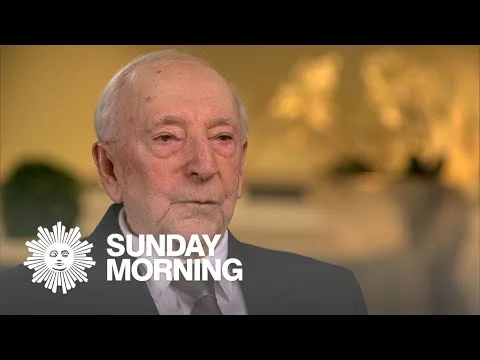
CBS Sunday Morning on the Cologne tank duel and Adam Makos's Spearhead.
He also photographed Nordhausen, the concentration camp built around the V2 rocket program, where slave laborers were worked to death in underground tunnels. He documented the cremation ovens, the mass graves, the evidence of what had been done there. He chose not to keep personal photographs from Nordhausen. That choice says as much about who he was as anything he did keep.
After the war he went home to Colorado Springs. D.M. Alexander was building a new building when Jim walked in, and didn't even turn around, just said Jim, where in the hell have you been, we've been waiting for you. Jim spent twenty-nine years at Alexander Film in total. Hollywood had come calling after the war: contacts at Disney, MGM, Columbia. He turned them down. He came home, married Monica Howard, the English woman he'd met during the war, and made pictures for the rest of his life.
About a year before Clarence Smoyer died, Adam Makos's brother introduced us and set up a phone call. I spoke to Clarence, the man whose tank my grandfather filmed, whose face was on the cover of that book. It was a privilege I still treasure.
After the war he went home to Colorado Springs. D.M. Alexander was building a new building when Jim walked in, and didn't even turn around, just said Jim, where in the hell have you been, we've been waiting for you. Jim spent twenty-nine years at Alexander Film in total. Hollywood had come calling after the war: contacts at Disney, MGM, Columbia. He turned them down. He came home, married Monica Howard, the English woman he'd met during the war, and made pictures for the rest of his life.
About a year before Clarence Smoyer died, Adam Makos's brother introduced us and set up a phone call. I spoke to Clarence, the man whose tank my grandfather filmed, whose face was on the cover of that book. It was a privilege I still treasure.
His son, also named Jim, followed in his father's footsteps and became a commercial photographer. He ran the Bamberger's photo studio (Macy's) for decades, shooting catalog and commercial work with large-format cameras. He worked many Saturdays when I was a kid, and I spent nearly every one of those Saturdays in the studio with him. He taught me how to change large-format sheet film in the dark by feeling for the notches on the top edge of the film, how to develop black and white negatives. A different application of the same inheritance. Precision, patience, discipline, and the passion for making well-composed images. He passed it to me the same way Jim passed it to him: not through instruction manuals, but through presence.
While I've shot everything from weddings and corporate events to products and landscapes, I'm a headshot and portrait photographer now, based in a studio in Sherborn, Massachusetts. Before I came back to photography professionally I spent 35 years in corporate leadership (MassMutual, MetLife, Manulife Financial), building teams, leading product strategy, serving as a company media spokesperson. I've sat in the chair my clients sit in. I've made high-stakes first impressions and presentations in boardrooms and understood firsthand how much a single image shapes how someone is perceived before they say a word.
I'm also an ExPI-certified executive coach. The framework I used to work with C-suite leaders on how they show up is the same lens I bring to a headshot session. I'm not trying to make you look like someone else. I'm trying to find the version of you that reads the way you want to be read, and coach you into it, frame by frame.
Three generations. A combat photographer. A commercial photographer. A kid who spent his Saturdays in a darkroom and his summers on a Nova Scotia road learning to see.
The eye gets trained somewhere. Mine got trained here.
I'm also an ExPI-certified executive coach. The framework I used to work with C-suite leaders on how they show up is the same lens I bring to a headshot session. I'm not trying to make you look like someone else. I'm trying to find the version of you that reads the way you want to be read, and coach you into it, frame by frame.
Three generations. A combat photographer. A commercial photographer. A kid who spent his Saturdays in a darkroom and his summers on a Nova Scotia road learning to see.
The eye gets trained somewhere. Mine got trained here.